Tiger Woods was moving quietly through the airport terminal, blending almost seamlessly into the flow of travelers, when something unusual caught his attention: a small child standing completely alone, clutching a backpack and blinking rapidly as panic crept across his face.
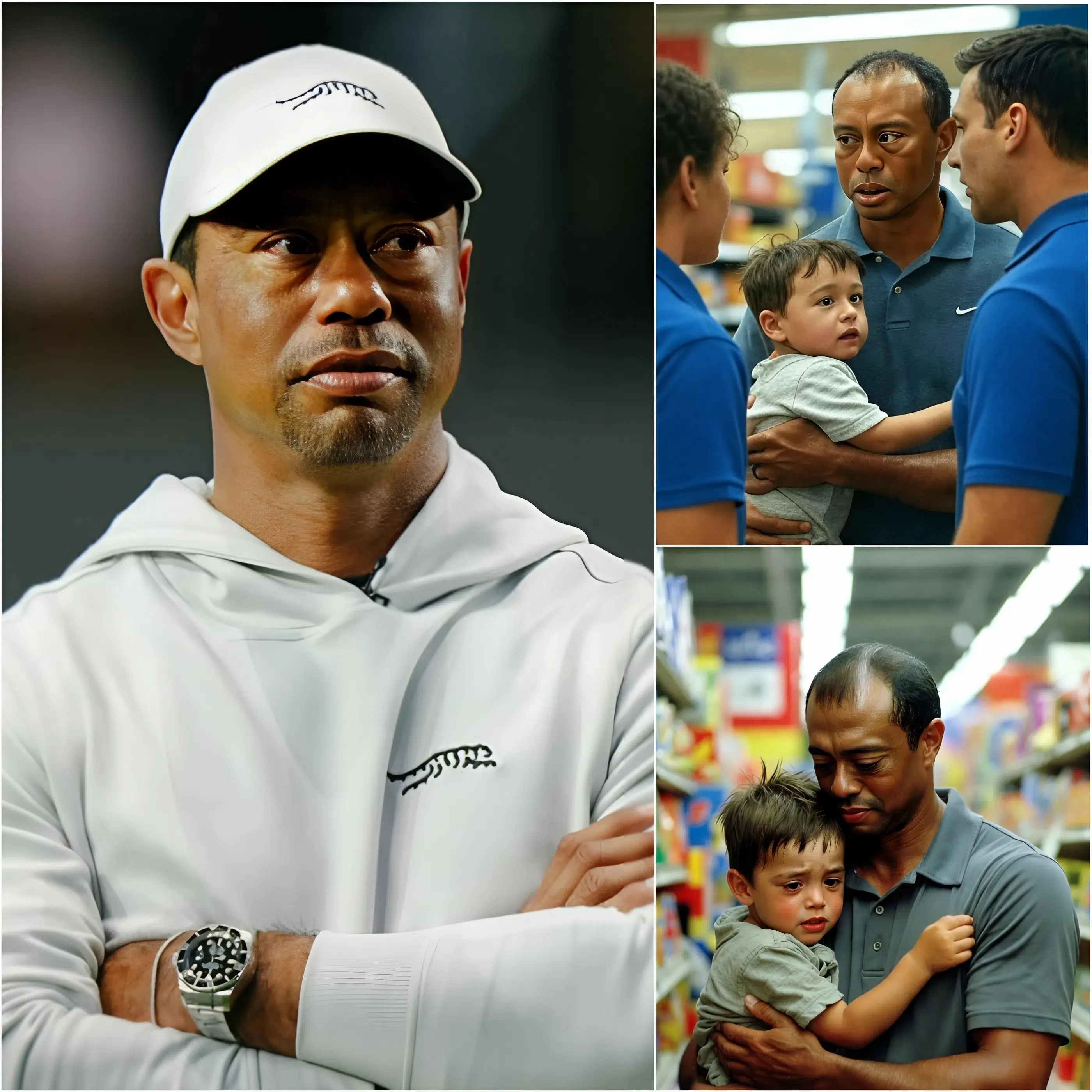
Woods slowed his pace immediately, noticing the way the boy kept turning in circles, searching for someone who clearly wasn’t nearby. People rushed around him, rolling suitcases, scanning boarding passes, and never once stopping to see what was wrong.
Tiger stepped away from the moving crowd and approached gently, making sure his posture wasn’t intimidating. Witnesses later said he looked more like a concerned parent than a global sports icon as he crouched down beside the distressed child.
The boy hesitated at first, startled by someone finally acknowledging him. Tiger’s calm voice seemed to dissolve that initial fear, and soon the child’s wide, shaking eyes lifted to meet his. The relief was immediate, as if someone had finally given him permission to hope.
Airport employees noticed the interaction and began slowing their own pace. From a distance, they could see Woods extending his hand—not with authority or fame, but with patience. The child stared at the gesture, then placed his trembling hand in Tiger’s.
In that instant, something shifted in the entire terminal. A few travelers paused mid-step, recognizing the familiar face kneeling beside the boy, though the scene unfolding was nothing like the public image they were used to seeing. It was simply human, raw, and real.
Tiger asked the child for his name, where he had last seen his parents, and whether he knew what gate they were heading to. The boy shook his head repeatedly, unable to find words, overwhelmed by fear and noise.
Realizing the child needed stability, Woods smoothly stood while keeping hold of his hand. He signaled to a nearby staff member, requesting immediate assistance without raising his voice or causing a spectacle. His composure radiated authority without aggression.
Security personnel began to organize a quick response, and within moments, their radios crackled with updates. What had started as a silent crisis for a single child was now a coordinated effort led—unexpectedly—by a sports legend.
Several passengers whispered among themselves, unsure if they were witnessing a celebrity moment or something far more meaningful. Many soon realized they were observing an act of compassion that transcended fame, turning an ordinary airport hallway into a powerful reminder of human kindness.
As security surrounded the area discreetly, Tiger guided the child toward a quieter corner of the terminal. He kept speaking softly, telling him that everything would be okay, maintaining a steady tone that anchored the boy’s spiraling emotions.
The child finally muttered a few broken details about losing sight of his parents near a coffee stand. Tiger listened carefully, piecing together what little information he could, ensuring nothing was overlooked. His attention never wavered for even a second.
A few airport workers later admitted they had never seen someone so famous behave with such grounded empathy. There were no cameras, no agents, no publicists—only Tiger and a frightened child who badly needed someone to care.
Meanwhile, airport monitors flashed internal alerts requesting the child’s parents to approach security immediately. Footsteps echoed in the distance as staff fanned out across the terminal, scanning every corner for signs of a frantic family.
Tiger remained beside the boy, refusing to step away even when staff assured him he’d done more than enough. To him, the situation wasn’t resolved until the child felt safe again, not just accounted for on paper.
Passengers continued gathering nearby, drawn by the quiet but compelling scene. Some filmed briefly before being asked to step back, while others watched in respectful silence, sensing that interrupting would feel inappropriate.
Minutes passed before a couple suddenly appeared at a sprint, faces pale and eyes wide. They had been searching in the opposite direction, unaware their child had wandered so far from where they last saw him.
The moment the boy recognized them, his entire posture collapsed into relief. Tiger stepped aside slightly, letting the child run forward while maintaining a protective presence behind him in case confusion or fear resurfaced.
The parents reached their son, wrapping him in a tight embrace, tears of exhaustion and gratitude spilling without restraint. It was a reunion charged with so much emotion that even strangers watching felt their chests tighten.
Only after confirming the child was truly safe did Tiger offer a reassuring smile and take a subtle step back. He didn’t expect recognition or thanks; he simply nodded politely as the parents tried to express their overwhelming gratitude.
Security officers offered to escort the family to their gate, but the parents insisted on taking a moment to thank Woods properly. Tiger accepted their words quietly, responding with humility and reminding them that any parent would have done the same.
As the family walked away, still shaken but finally united, the terminal seemed to exhale collectively. What could have been a tragic, chaotic ordeal had been softened by the presence of someone who chose empathy instead of indifference.
Tiger resumed his walk, blending once again into the river of travelers. Yet the energy around him had changed. People stepped aside with newfound respect, whispering not about trophies or championships but about character and compassion.
Several witnesses later admitted they had never seen a public figure so unaffected by attention. One traveler described it as “watching a hero be human in the best possible way,” a sentiment echoed repeatedly across social media hours later.
Others reflected on how easily everyone else had walked past the lost child, too caught up in their own worries to notice. The moment served as a subtle reminder of how quickly a small act can alter someone’s entire world.
By the time Tiger reached his gate, the incident had already become airport folklore. Employees exchanged stories, passengers sent messages to friends, and the child’s parents asked security for information so they could thank Woods again later.
Tiger never commented publicly on the event, and those present said he didn’t need to. His actions had spoken loudly enough, leaving an imprint on everyone who witnessed them—a moment of rare kindness in a place defined by rushing and disconnection.
Long after he boarded his flight, passengers continued talking about what they had seen. It wasn’t the story of a superstar; it was the story of a man who decided to stop when others didn’t, and in doing so, changed an entire room’s perspective on empathy.
What remains clear is that the airport fell into a hush that few places ever experience, all because Tiger Woods noticed one child, knelt down, and cared enough to act. And for many who watched, that quiet moment may linger far longer than any championship highlight.